
Greetings SGI Families,
I’m writing this short article as an update on a POST FROM LAST SPRING. After piloting a concept called “Zones of Regulation” in about a dozen elementary classrooms, we’ve been rolling it out universally in grades UPK-6. The purpose of this article is to share the concept with families so that you can support the work at home, as well.
WHY is SGI Doing This?
The ability to self-regulate or control one’s emotions in a variety of situations and circumstances is directly correlated with success both inside and outside of school. It makes sense, right? If our children can persevere through challenges when things get tough, they will be well-equipped to handle the many situations that they will encounter as children, adolescents, young adults, and in their lives after leaving SGI.
How is SGI Teaching This?
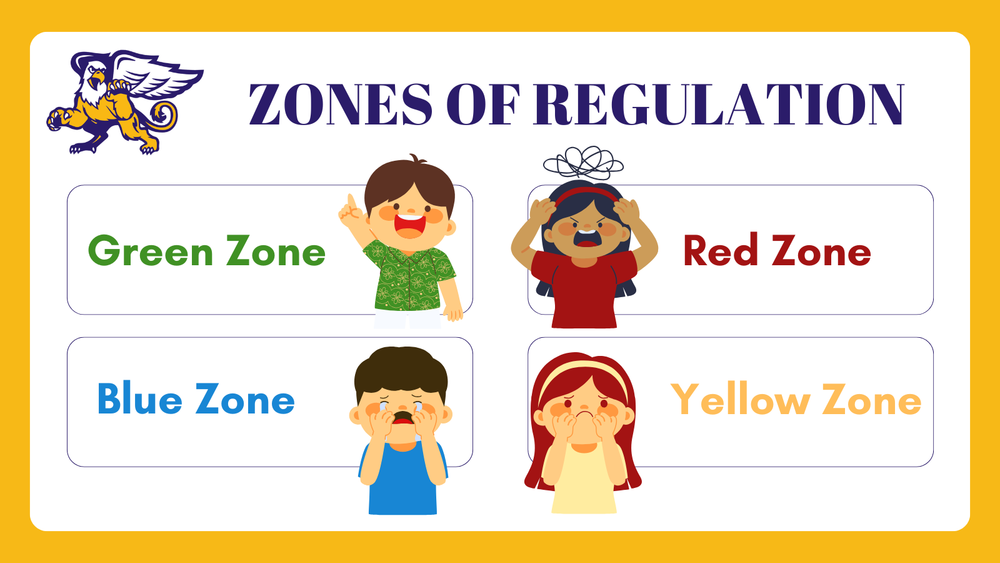
The Zones of Regulation concept is relatively simple. We first help students learn about their emotions and how to name them. Students will use a simple four-color matrix to describe their emotions:
“Green Zone”: Calm/Ready/etc.
“Blue Zone”: Sad/Tired/etc.
“Red Zone”: Angry/Upset/etc.
“Yellow Zone”: Excited/Worried/etc.
You can’t regulate your emotions if you don’t first know how you are feeling. Second, we work with students to develop simple strategies to employ when they are feeling a certain way. For example, if a friend takes your toy and that makes you upset, can you calm yourself down by counting to five, and then asking the person for the toy back?
At this point, students at Springville Elementary School, Colden Elementary School, and sixth graders at Springville Middle School have received two lessons in the Zones of Regulation. To help this stick, we will be using two questions universally throughout our classrooms to reinforce the concept. If a student seems dysregulated, an adult can simply ask:
What zone are you in?
What are your strategies to work through it?
Families are encouraged to ask these same questions at home as additional practice for students, which will help to reinforce the concept.
Important Points:
There are a couple of key points that we are emphasizing with students when teaching these lessons: (1) All emotions are okay-you will feel a variety of different ways during each day, and emotions are simply our body’s way of giving us signals to how we are feeling. (2) How you respond to your emotions can be “appropriate” or “inappropriate”. The goal, of course, is to give our students strategies to respond to their emotions appropriately. (3) The amount of time that it takes to “work through” an emotion can vary, and we need to be understanding and respectful of the fact that sometimes emotions take longer to subside.
We hope that these simple lessons and strategies will go a long way in helping our students become more resilient, develop self-efficacy, and take on the inevitable challenges that they will face. We appreciate any support that you can provide to strengthen their self-regulation.
James Bialasik
SGI Superintendent