
Following a comprehensive review of enrollment trends, facility capacity, transportation logistics, and community feedback, the Springville-Griffith Institute Central School District Elementary Configuration Steering Committee has reached consensus to recommend maintaining the district’s current elementary organization.
Under the consensus recommendation, also referred to as Option 1 in the survey, Springville Elementary and Colden Elementary will continue to operate within their existing attendance boundaries and grade structures. Rather than making major redistricting shifts or structural reorganizations, the district will address enrollment variance through targeted annual monitoring and responsive, year-to-year adjustments to staffing, section counts, and classroom resources.
As a result of this clear consensus, the public meeting previously scheduled for November 10 has been canceled. The Steering Committee’s final recommendation will be presented to the Board of Education at an upcoming meeting.
A Collaborative, Data-Driven Process
Formed to evaluate how long-range enrollment trends impact elementary education, the Steering Committee met twice to examine district data, analyze operational considerations, and evaluate feedback from a districtwide community survey.
The committee represented a cross-section of district constituents, including community members, parents, teachers, school staff, administrators, and Board of Education members. Together, the group evaluated three potential solutions:
Option 1 (Maintain Current Configuration): Preserve existing neighborhood boundaries and grade structures while managing annual enrollment shifts flexibly.
Option 2 (Adjust Attendance Boundaries): Redraw elementary attendance lines to balance student counts between buildings.
Option 3 (Create Grade-Level Centers): Reorganize buildings into a UPK–Grade 1 Primary School and a Grades 2–5 Intermediate School.
Community Survey Highlights Strong Support for Stability
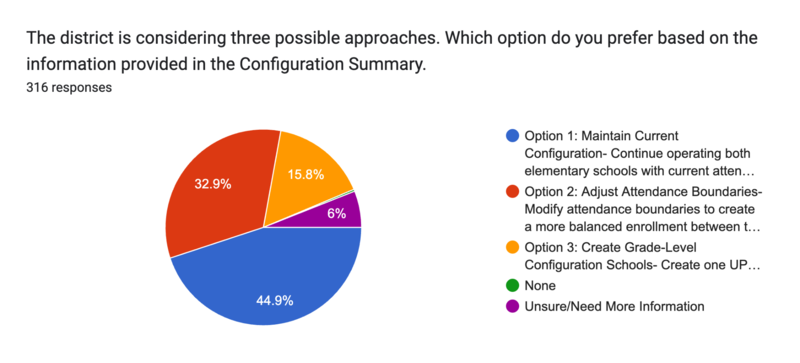
The Steering Committee designed and fielded a community survey between October 7 and October 21, receiving 315 responses—84% of which came directly from elementary parents and guardians.
When asked to evaluate the options, Option 1 emerged as the single most selected choice among community members (44.8%). Furthermore, nearly 78% of respondents favored maintaining separate, community-based elementary schools over creating districtwide grade-level centers.
Key findings from the survey underscored high confidence in the district's current educational program:
72.0% of respondents agreed that students receive a high-quality education regardless of which elementary school they attend.
74.6% of respondents agreed that current class sizes effectively support student learning.
Student achievement and academic excellence were identified as the highest priorities by 70.8% of respondents, followed closely by maintaining small, balanced class sizes (56.1%) and managing transportation time (45.8%).
Minimizing Disruption and Prioritizing Family Needs
While Option 2 (adjusting attendance boundaries) presented a theoretical way to balance building populations, the committee’s analysis revealed that redrawing boundaries would require approximately 42 families to change elementary schools.
After examining student impacts, the committee concluded that forcing dozens of young children to switch schools was not justified by the minor balance it would achieve. Community feedback echoed concerns over unnecessary transitions, longer winter bus routes, disruptions to established special education supports, and split family schedules. As one parent noted in the survey responses, "These young students have already endured a lot of change... Forcing another change on them will not be settling at such a young age."
Responsible Stewardship & Next Steps
While total K-5 enrollment has remained steady over the past several years (679 students in 2026–27), shifting residential patterns have resulted in gradual growth at Colden Elementary alongside slight declines at Springville Elementary.
Rather than implementing widespread boundary shifts now based on fluctuating trends, Option 1 empowers the district to make agile adjustments year by year—such as reallocating teaching sections to prevent localized class-size spikes.
The district will continue to track incoming kindergarten registrations, residential trends, and section sizes annually. If multi-year data demonstrates that class sizes or program access cannot be sustained through routine annual adjustments, the configuration could be re-examined in the future.
The district expresses its sincere gratitude to all Steering Committee members and community survey respondents for their time, insight, and commitment to SGI's elementary students.